On The Work Before Love
On Whisper of the Heart, Family, and the Formation Required to Be Worthy of Another
“Country roads, take me home…”
We sat down together as a family to watch Whisper of the Heart, part of a pattern that has quietly taken hold in our home. These Japanese animated films, like My Neighbor Totoro and Spirited Away, have become a deliberate alternative to what most modern media offers. We do not put them on casually. We choose them. One at a time. We watch them the way they are meant to be watched: without distraction, at their pace, not ours.
That pace is slower, almost resistant. Scenes linger longer than expected. Nothing is forced forward. The animation itself reinforces it. Hand-drawn, textured, attentive to ordinary things: a train passing at dusk, a quiet street, light settling into a room. But what holds my attention, sitting there with my children, is not just the craft. It is the ethic embedded in it. These films assume something that is no longer commonly assumed: that character is built, not declared; that effort is a prerequisite, not an accessory; that becoming someone, truly becoming, takes time. And more pointedly, that before you ask to be chosen, you must first become someone worth choosing.
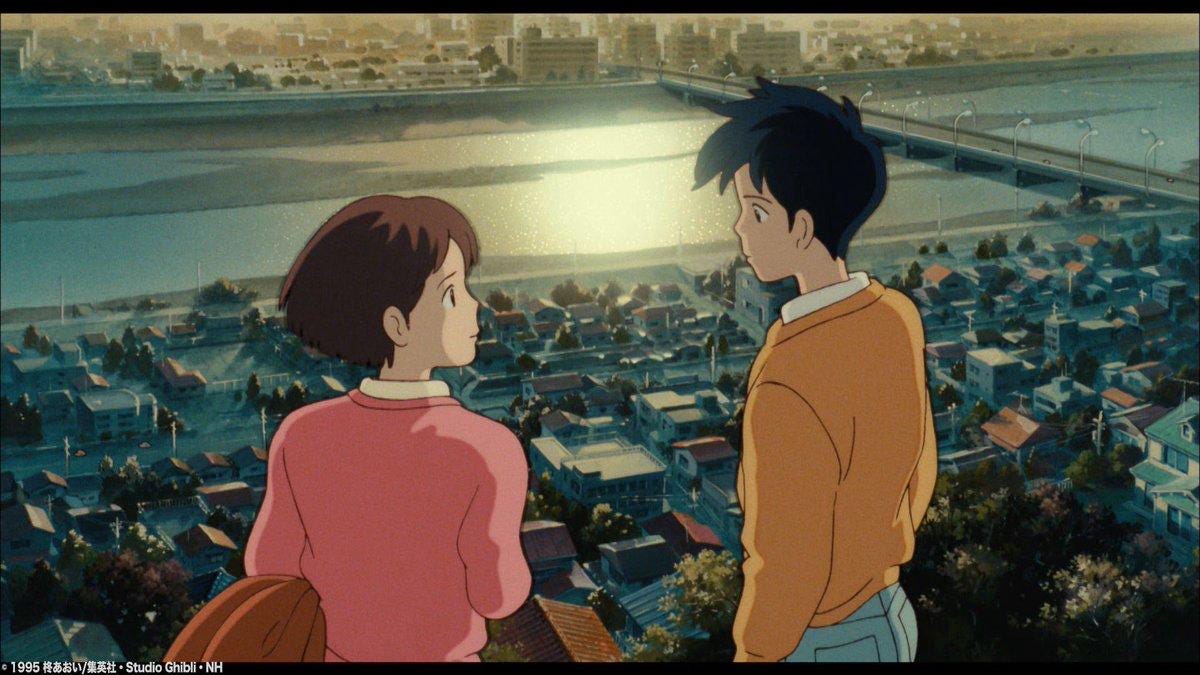
Watching it that way changes the experience. I am not just following a story; I am observing a set of values play out in front of my children. The relationship between Shizuku Tsukishima and Seiji Amasawa is not presented as something to fall into. It is something that must be earned. That is what held my attention. Seiji has already chosen a path. He is committed to a craft, willing to leave home, willing to be tested. He wants to be the best violin maker in the world. Shizuku, at the beginning, is not there. She is capable, but scattered. Their interaction does not resolve that difference, rather it exposes it and brings it to life.
That exposure is uncomfortable. It should be. Watching it as a father, I found myself thinking less about the romance and more about that moment of recognition, when a young person realizes that potential is not the same as substance. It is a difficult threshold. The film does not soften it. It lets Shizuku feel the weight of it.
What follows is the core of the film. She decides to write, not casually, but seriously. She produces something, and it is not good enough. That is the point. The old craftsman explains it plainly: early work is raw; it has to be shaped. There is no immediate reward, no validation loop. Only repetition, correction, and time. Hard things are hard and they need to be approached with conviction.
Sitting there with my family, I kept returning to that sequence. My children will reach an age where they want to be taken seriously, by friends, by the world, eventually by someone they might love. The question is whether they will have built anything that justifies that seriousness. Not status, but discipline. Not image, but direction. The ability to stay with something when it is still rough. Simply, will they be worth someone else’s time.
Seiji’s decision to leave reinforces the same principle. He does not stay to maintain proximity to Shizuku. He goes to pursue mastery. The relationship is not the center; the work is. Only because of that does the relationship carry weight at all.
This is where the film diverges sharply from most modern narratives. Much of what is produced today is optimized for speed. Quick attachment, quick conflict, quick resolution. The emphasis is on feeling rather than formation. In contrast, this film assumes something closer to an older standard, one that would not be out of place in the thought of Aristotle: that meaningful relationships rest on the prior development of the self. Respect precedes attachment. Competence precedes commitment. Direction precedes union. Virtue is the chief aim, not fame or glory.
That assumption gives the story a different weight. It also makes it more useful. These films do not lecture. They present a world where effort is normal, where craft is respected, where time is required. Watching them as a family is not just entertainment; it is exposure to a standard.
I do not want my children to internalize the idea that they must become something for the sake of being chosen. That is unstable. What I want and what this film quietly models, is that they become something because that is the baseline they set for themselves. If they do that, the right relationships will align with it. If they do not, no amount of external validation will compensate.
The final scene is often interpreted as a promise. It is better understood as a commitment to a trajectory. Neither character has achieved mastery. What they have done is choose a direction and accept the cost that comes with it. The relationship exists within that framework, not outside it.
When the film ended, the feeling was not sentimental, rather it was clarifying and heavy. Sitting there with my family, it reinforced something simple but easy to neglect: the order matters. First build the person. Then, if it comes, build the relationship. Country roads, take me home…


