

“The future is already here, it is just not evenly distributed.” - William Gibson
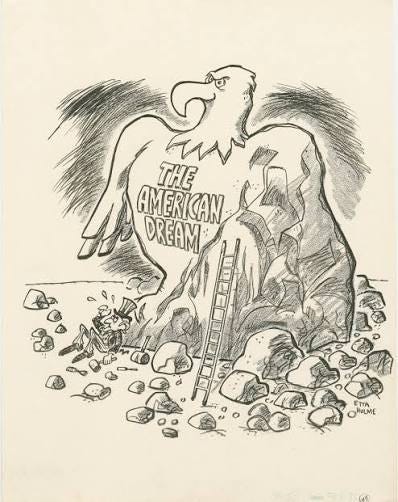
GOOOOAAALLLL. During World Cup festivities - I was playing soccer with my six-year-old son when I found myself thinking about how different his childhood is from my own. I was six years old in 1994, a decade that has become the object of almost constant nostalgia. We remember the Teenage Mutant Ninja Turtles, Power Rangers, the early internet, MTV, and a world that, in retrospect, seems simpler and more optimistic. Yet the differences between our childhoods extend far beyond popular culture. My son is growing up in a world of extraordinary technological progress and unprecedented opportunity. At the same time, many people have come to believe that the opportunities available to previous generations are no longer within reach, that the American Dream has become little more than a story our parents told us or we’ve seen in movies.
I do not believe that is true. I believe the dream remains attainable for far more people than our public discourse suggests. What has changed is not the existence of opportunity, but our understanding of what it now requires. The essay that follows is an attempt to explain why so many Americans feel as though they have fallen behind, why our cultural benchmarks no longer match our economic reality, and why a more honest understanding of that reality can restore both clarity and optimism.
Every generation inherits a vocabulary of success. Parents teach their children what a good income looks like, what kind of education matters, which careers appear secure, and what milestones signify that adulthood has gone well. These ideas are rarely examined closely because they are passed down as practical wisdom rather than economic theory. They seem durable because they were once true.
For much of recent American history, one number stood above the others: $100,000. To earn “six figures” was to have made it. The phrase signified more than salary. It suggested professional competence, financial security, and entry into the upper reaches of the middle class. A six-figure income was assumed to support a desirable home, children, retirement savings, annual vacations, and a degree of protection against ordinary misfortune. It represented not extravagance, but margin.
That number remains embedded in the American imagination. Parents still encourage their children to choose careers that can produce six-figure incomes. Employers still treat the threshold as a mark of professional achievement. Young workers continue to organize years of education, credentialing, and career advancement around reaching it. Yet many who finally cross the line experience not arrival, but confusion. They have reached the benchmark they were taught to pursue, but the life associated with it has failed to appear. Today, earning just ix figures is almost a joke.

The American Dream did not disappear so much as it quietly became more expensive. Our language, however, never changed. We continue using economic categories inherited from the 1990s as though the numbers still carry the same meaning. The result is a form of cultural lag in which the economy has moved forward while our expectations remain fixed in an earlier age.
This lag matters because people interpret economic disappointment as personal failure. A professional earns $120,000, $150,000, or even $200,000 and wonders why the promised security still feels fragile. The explanation often takes a moral form. Perhaps the family spends too much, purchased the wrong house, chose the wrong profession, or lacks discipline. Sometimes those criticisms are justified. Often they are not. Many households are simply discovering that the benchmarks by which they were taught to measure success are no longer reliable.
The first explanation offered is usually inflation. That explanation is correct, but incomplete. General consumer prices have risen substantially since the mid-1990s. A dollar today purchases far less than it did thirty years ago, and a salary that once appeared exceptional must therefore be adjusted upward merely to preserve equivalent purchasing power. By conventional inflation measures, $100,000 in 1994 is worth roughly $225,000 today.
That figure alone is startling. It reveals how much economic meaning has been drained from the six-figure threshold. A household earning $100,000 today may still be doing well, especially in a lower-cost region, but it does not occupy anything close to the social or economic position that a $100,000 household occupied in 1994. The same number has survived while the value beneath it has eroded.
Yet ordinary inflation still does not explain the full shift. The most important costs of modern family life did not merely rise alongside groceries, clothing, and gasoline. Many rose much faster. Housing appreciated beyond general consumer prices. College tuition became a defining financial burden rather than a manageable household expense. Childcare evolved into one of the largest line items in the budgets of working families. Healthcare costs expanded while becoming more complex and less predictable. These are not peripheral goods. They are central to what Americans mean when they describe a stable and successful life.
This distinction is essential because inflation is not experienced evenly. Some things have become remarkably cheap. Consumer technology is the clearest example. A modern smartphone contains computing power, communication tools, navigation, photography, entertainment, and access to information that would have seemed miraculous in 1994. Televisions are larger and cheaper. Communication is nearly free. Entertainment is virtually unlimited. Many household products are better, safer, and more convenient than those available to earlier generations.
By these measures, modern Americans are extraordinarily wealthy. They enjoy forms of abundance that even affluent households could not purchase a generation ago. Yet abundance in consumer technology does not necessarily produce the kind of security people associate with prosperity. A family may possess better devices, safer cars, and more entertainment while remaining anxious about housing, education, healthcare, and retirement.
The reason is that human beings do not measure economic success through consumer goods alone. They measure it through access to scarce and socially meaningful goods. A desirable neighborhood cannot be mass-produced like a smartphone. A respected school district has limited geographic boundaries. A short commute depends on proximity to employment. A safe community with parks, libraries, and stable institutions cannot expand infinitely without changing what made it desirable in the first place.
These are positional goods. Their value depends partly on scarcity and partly on their relationship to social standing. As a society becomes richer, competition shifts increasingly toward goods that cannot be manufactured in unlimited quantities. Nearly everyone can acquire better electronics over time. Not everyone can acquire the same house, the same school, the same neighborhood, or the same institutional access.
Prosperity therefore begins to resemble an auction. Families bid against one another for a limited supply of desirable homes, school districts, university placements, and geographic access. When professional households earn more, the prices of these goods often rise with them. A raise that would once have produced greater freedom may now be absorbed by the cost of remaining competitive in the same housing market or educational environment.
This dynamic helps explain why many high-income households do not feel wealthy. Their income may place them far above the national median, but much of that advantage is consumed by the price of maintaining access to the institutions and environments they believe are necessary for their children. Their standard of consumption is historically impressive, yet their sense of security remains limited because the goods that matter most continue to move away from them.
The changing structure of household labor compounds the problem. A successful professional household in 1994 was more likely than its modern counterpart to rely primarily on one income. The wage earner generated cash income while the other spouse often performed the extensive unpaid labor required to sustain family life. Meals were prepared, children transported, appointments managed, laundry completed, homework supervised, and social obligations maintained without appearing as purchased services in the household budget.
That arrangement was not universally desirable, nor was it equally available to all families. It often reflected gender expectations that limited women’s professional choices and financial independence. Still, its economic significance should not be ignored. A one-income household possessed not only a salary but a large reserve of unpaid labor and time.
Modern professional households often produce more income precisely because both adults work. This increases cash earnings, but it also removes labor from the home. Much of what was once performed internally must now be purchased through childcare, cleaning, prepared food, tutoring, after-school programs, summer camps, and delivery services. Other tasks are simply compressed into evenings and weekends, producing households that are affluent in income but poor in time.
This is one of the least discussed forms of inflation. The cost of living has risen, but so has the cost of maintaining a functioning household when both adults are required to work at a high level. A family may earn $250,000 and still experience considerable strain, not because the income is insignificant, but because it is purchasing both a lifestyle and the labor necessary to sustain that lifestyle.
The shift from one high earner to two professional earners also changes the meaning of household income. A family earning $100,000 in 1994 may have relied on one unusually successful worker. A family earning $300,000 today is often combining two demanding careers. The modern household may appear three times as prosperous on paper, but that income can require twice the commuting, twice the professional risk, twice the scheduling pressure, and far less flexibility in the event of illness, childbirth, or family disruption.
This does not mean the earlier household was necessarily happier or that the modern household is worse off in every respect. It means income figures conceal the amount of labor required to generate them. A household earning $300,000 through two full-time careers is not economically identical to a household earning the equivalent amount through one. The second arrangement contains a reservoir of time that the first does not.
Once these changes are considered together, the old six-figure benchmark becomes difficult to defend. In 1994, a household earning $100,000 made roughly three times the median household income. It occupied a position that was not merely comfortable but distinctly elevated. That relative status mattered because it provided access to better housing, greater savings capacity, and a larger margin for error.
If the goal is to identify the modern income that occupies a broadly comparable position, the answer is not simply the inflation-adjusted figure of approximately $225,000. It is closer to $300,000. That amount reflects not only the decline in the purchasing power of money but the rise in median incomes and the intensified competition for housing, education, childcare, and other positional goods.
The figure sounds extreme because our language remains anchored to an earlier economy. We still speak of $300,000 as though it necessarily represents lavish wealth. In some regions and household structures, it does. A family without children, debt, or major housing costs can live exceptionally well on that income. Geography, family size, inherited assets, and lifestyle choices matter enormously.
Yet as a national aspirational benchmark, $300,000 is not an absurd number. It is a plausible modern approximation of the economic and social position once associated with a $100,000 household. It represents the income at which a professional family may be able to purchase a desirable home, raise children, save substantially, travel periodically, and retain some financial margin without every decision becoming an exercise in tradeoffs.
This does not mean that people earning less have failed or cannot live meaningful lives. A good life cannot be reduced to a salary threshold. Families with modest incomes often possess stronger communities, more time, less status anxiety, and a clearer sense of purpose than households earning many times more. Nor should every person organize his life around maximizing income. Wealth is a means, not a complete account of human flourishing.
But cultural benchmarks still matter. They shape education, career choice, marriage, fertility, housing, and savings. If society continues to tell young adults that $100,000 represents the summit of professional success, it encourages them to plan around an income that may not support the life they have been led to expect. This is not merely inaccurate. It is destabilizing.
An honest benchmark permits better decisions. A young person who understands the modern cost of upper-middle-class life may choose a different field, pursue a scarce credential, relocate to a lower-cost region, start a business, or begin investing earlier. A couple may think more carefully about whether both careers are necessary, how many children they hope to raise, and what tradeoffs they are willing to make between time and income.
The purpose of naming $300,000 as the new bar is not to glorify money. It is to replace nostalgia with clarity. People cannot plan effectively around numbers that no longer describe reality. They should know that six figures remains a meaningful achievement, but not the achievement it once was. A $100,000 income today may represent professional stability. A $150,000 or $200,000 income may represent substantial individual success. The household income associated with the old upper-middle-class ideal, however, has moved considerably higher.
There is a tendency to treat this conclusion as pessimistic. It need not be. A higher benchmark can be discouraging, but it can also be clarifying. Three hundred thousand dollars is a large income, yet it is tangible. It can be reached through two strong professional salaries, a successful business, specialized medical or technical work, senior management, commission-based careers, investment income, or some combination of these sources.
The path is difficult, but difficulty is not the same as impossibility. The more damaging message is to conceal the actual distance and allow people to believe they have arrived when they have not. False reassurance produces poor planning, delayed disappointment, and resentment. Accurate information produces agency.
The American Dream has always required adaptation. Earlier generations moved across oceans, left farms for factories, migrated from small towns to industrial cities, and later pursued education as the gateway to professional life. The modern economy demands its own adjustments. Education remains important, but credentials alone are not sufficient. Income must often be paired with ownership, investment, geographic strategy, and deliberate control over household costs.
These changes may be undesirable in some respects. A society in which two adults must work at maximum capacity to reproduce the lifestyle once supported by one successful income has not necessarily progressed in every meaningful sense. Greater income and better technology cannot entirely compensate for declining time, weaker communities, delayed family formation, or the exhaustion produced by constant economic competition.
Still, the first obligation is to describe reality accurately. Public discussion often swings between two equally unhelpful extremes. One side insists that the American Dream is dead and that effort no longer matters. The other repeats old advice and suggests that anyone struggling simply lacks discipline. The truth is less comforting but more useful. The dream remains attainable, but its cost has risen, its structure has changed, and the path toward it requires different choices.
There is an odd cruelty in telling young people to pursue yesterday’s benchmark and then judging them when yesterday’s benchmark no longer purchases yesterday’s life. We have allowed an entire generation to believe that reaching six figures should feel like arrival while withholding the fact that the destination itself has shifted.
The solution is neither resentment nor nostalgia. It is honesty. Honest benchmarks produce better decisions than comforting myths. If the modern equivalent of the old six-figure dream is closer to $300,000 than $100,000, then we should say so plainly. The number is high, but it is not imaginary. More importantly, it gives people a truthful map. No generation benefits from navigating with outdated coordinates. The American Dream did not disappear. We simply failed to update the price. So, get after it and grasp the AMERICAN DREAM!