

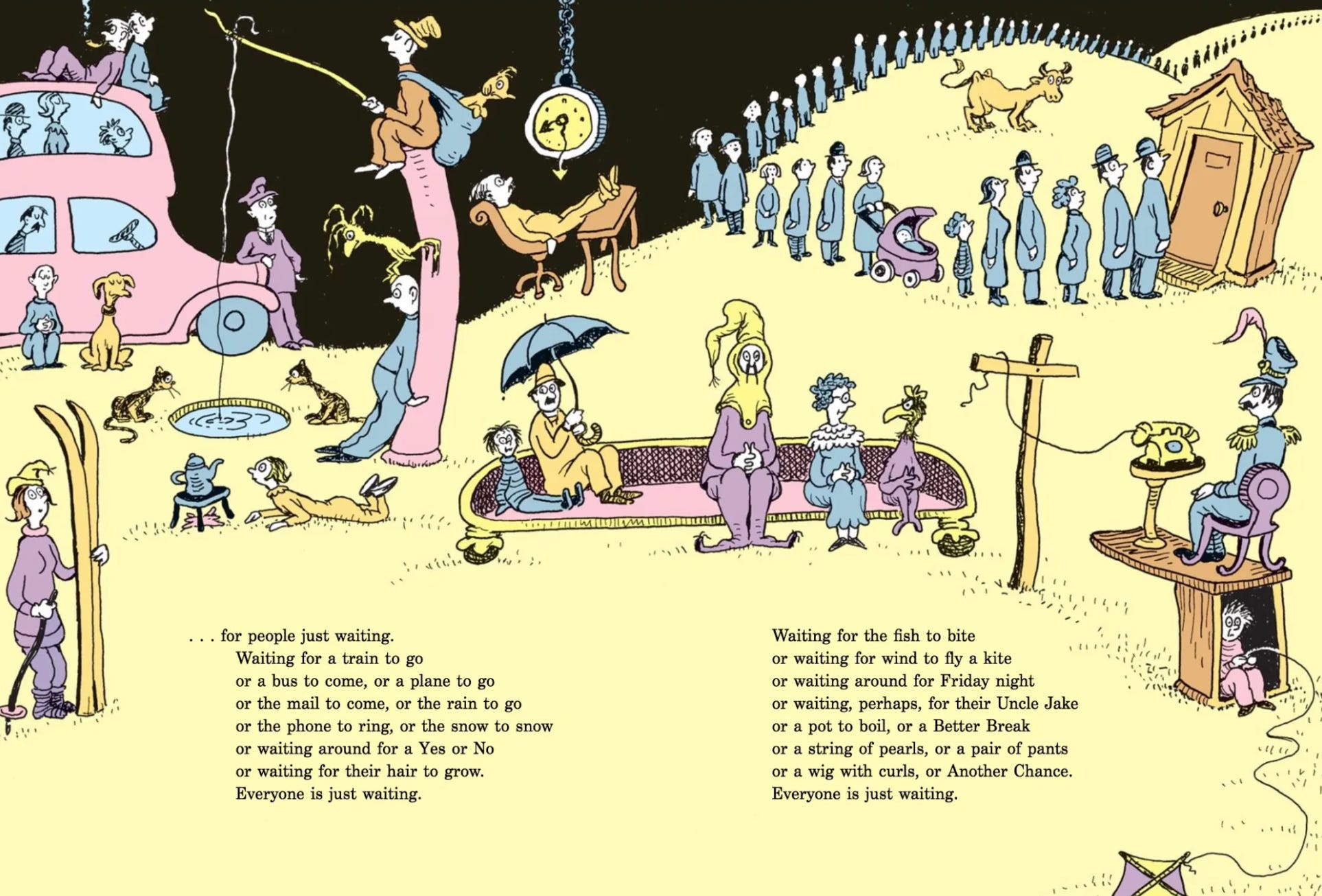
“Everyone is just waiting.” - Dr. Seuss, Oh, the Places You’ll Go!
I’ve read my children every Dr. Seuss book I could get my hands on, even the FORBIDDEN ones. This essay is not on one of the forbidden books (I’ll write a few in coming months), but rather on one that resonates with me at this time in my life - Oh, the Places You’ll Go! Or not go and that’s ok too….
Most people remember it as a celebration of possibility. It is given to graduates with heartfelt inscriptions and wrapped beside diplomas as though it were an anthem to optimism. We remember the colorful landscapes, the Ruth Goldberg machines, and the assurance that life is an adventure waiting to unfold.
Yet hidden within its pages is an interruption. The narrative pauses, the vibrant momentum disappears. Instead of mountains to climb or destinations to reach, Dr. Seuss presents a strange panorama of ordinary people engaged in remarkably ordinary acts. A man sits beneath an umbrella with nowhere apparent to go. Another stares at a silent telephone. Families stand patiently in line. Someone fishes. Someone waits for the rain to stop. Someone waits for a bus. Someone waits for another chance. Then comes the line: “Everyone is just waiting.”
As children, we glide over those words without reflection. Waiting feels temporary because childhood itself is a succession of rapid transformations. Every birthday brings new privileges. Every school year introduces new friends and teachers. Every summer seems impossibly long, every winter break impossibly distant. The future always arrives sooner than expected, and so waiting never feels permanent. It is merely the brief interval before something exciting happens. Adults discover a different truth.
The older one becomes, the more startling Seuss’s observation appears. It is not simply describing an episode of life. It is describing its prevailing rhythm that transcends time.
Most of us imagine that our lives consist of decisive moments separated by insignificant stretches of time. We remember graduations, parties, sexual encounters, weddings, promotions, births, funerals, vacations, and retirements. These become the landmarks by which we measure our years. Looking backward, however, it becomes apparent that these events occupy only a tiny fraction of our existence. A wedding lasts an afternoon. A promotion is announced over email and is quite uneventful. Even the birth of a child, among the most consequential events in any parent’s life, unfolds over the course of hours (if you are lucky).
What occupies the remaining decades? WAITING! Waiting for the text. Waiting for the interview. Waiting for test results. Waiting for children to come home. Waiting for the market to recover. Waiting for retirement. Waiting for spring. Waiting for tomorrow. You know, everyone is just waiting…
The realization is unsettling because it contradicts the story we habitually tell ourselves. We assume life occurs at its peaks, when in reality it is constructed almost entirely from the valleys between them. The extraordinary occupies our memories, but the ordinary occupies our days. We spend years anticipating moments that, once they arrive, dissolve almost immediately back into the quiet routines from which they emerged.
This truth has become particularly difficult to recognize in the modern world because contemporary culture has taught us to think of waiting as failure.
We live in an age that celebrates acceleration, execution and WINNING. Every advertisement promises immediacy. Meals arrive within minutes. Messages travel across continents instantaneously. Careers are measured by the speed of advancement rather than the quality of work. Even leisure has become optimized, curated, and scheduled. Efficiency has become such a dominant virtue that inactivity now feels vaguely immoral.
If we are not advancing, producing, consuming, or improving ourselves, we begin to suspect that we are somehow falling behind. Waiting has therefore acquired an undeserved reputation as wasted time.
The young graduate imagines that real life will begin after securing his first serious position. The ambitious employee convinces himself that fulfillment lies one promotion away. The entrepreneur postpones contentment until the business reaches profitability. The unmarried man quietly arranges his emotional life around the woman he hopes will someday say yes. Parents reassure themselves that life will become easier once the children reach the next stage. Those nearing retirement begin counting the years until freedom finally arrives.
Each expectation seems perfectly reasonable in isolation.Together, they form a dangerous habit of mind. They persuade us to inhabit the present only provisionally, as though today were little more than a waiting room for tomorrow.
This is perhaps the most subtle temptation facing ambitious men. Ambition itself is not the problem. Civilization has always depended upon individuals willing to sacrifice present comfort in pursuit of future achievement.
Cathedrals are not constructed by men content with immediate gratification. Businesses are not built by those unwilling to endure uncertainty. Fathers do not provide for their families without accepting years of difficult labor. The willingness to delay pleasure in pursuit of something greater remains one of the defining characteristics of maturity.
The danger emerges only when deferred gratification quietly transforms into deferred living. There comes a point at which preparation ceases to serve life and begins replacing it. One no longer works toward the future while remaining present in today; instead, one mentally emigrates into a future that never quite arrives.
The horizon continues retreating with every step forward. Yesterday’s dream becomes today’s expectation. Today’s expectation becomes tomorrow’s dissatisfaction. Without realizing it, we begin measuring our lives not by where we are, but by how far we remain from where we imagine we ought to be.
Dr. Seuss understood this long before most philosophers of productivity and self-improvement. In a children’s book spanning only a few dozen pages, he quietly inserted one of the clearest descriptions of the human condition ever written. Everyone is just waiting. Not because they are doing life incorrectly. Because that is what life has always been. The tragedy is not that we spend our lives waiting. The tragedy is that we mistake waiting for the absence of life, when it is, in fact, the very substance of it.
The waiting had not delayed life. The waiting had been life. And perhaps that is the deepest wisdom hidden within a children’s book. The measure of a life is not found in the handful of moments we spend arriving, but in the thousands of ordinary days through which we faithfully waited, worked, hoped, loved, and remained present while believing we were merely passing time.
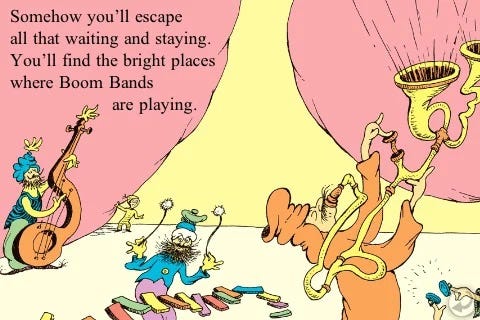
But, as the book continues, WAITING is not for you. Today is the day and you need to be on your way!