On The Offer You Can’t Refuse
Business Lessons Hidden in the Dialogue of The Godfather
A lawyer with his briefcase can steal more than a hundred men with guns. - Tom Hagen
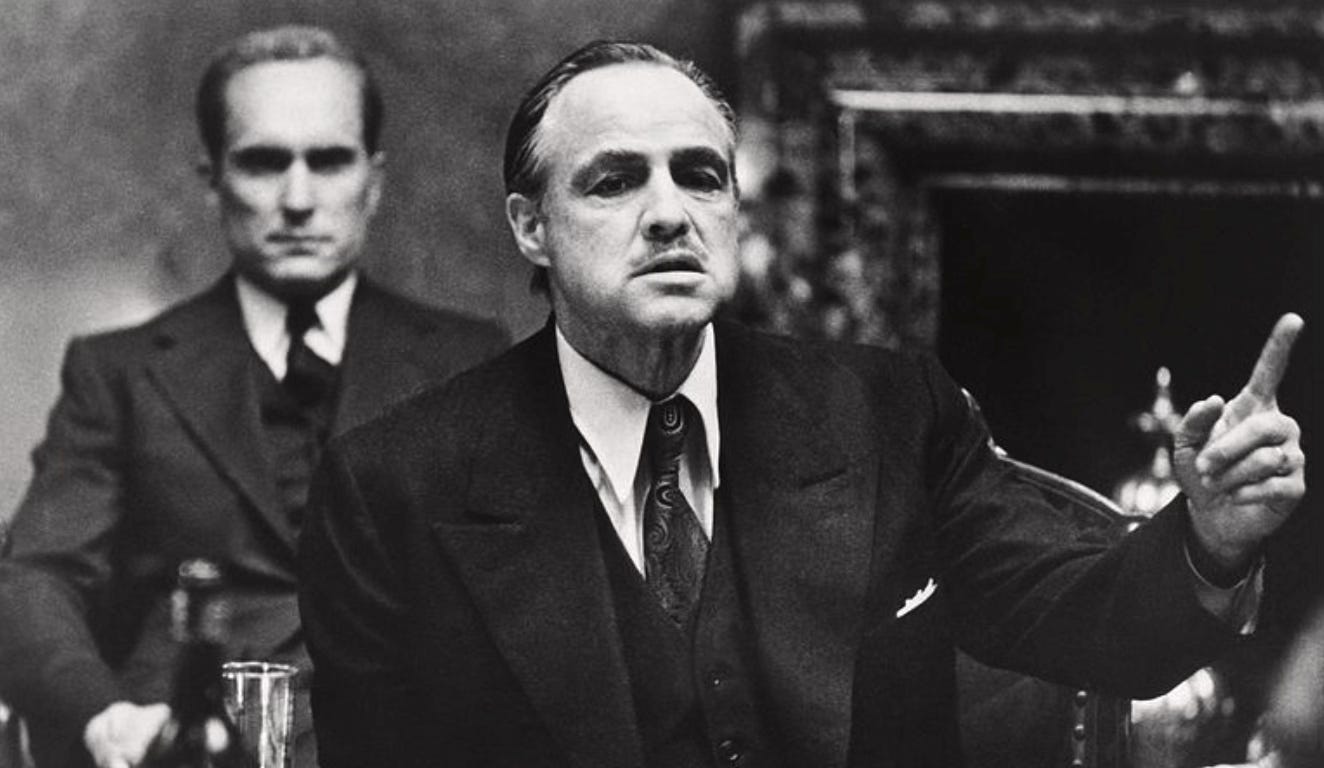
Few films are quoted as often as The Godfather, and fewer still are quoted with such misplaced nostalgia. What is usually treated as cinematic bravado is, on closer inspection, a dense manual on POWER, incentives, temperament, negotiation, and organizational design. Strip away the violence and the Sicilian ritual, and what remains is a study of business under conditions of extreme consequence. That is precisely why it endures.
What makes The Godfather unusually useful as a business text is not that it invents these lessons, but that it dramatizes them with absolute clarity. Coppola’s characters operate at the edge of consequence, where incentives are clean, feedback is immediate, and sentimentality is punished. For that reason, the film functions less like fiction and more like a compressed case study.
When its dialogue is placed alongside business and economic thinkers such as Charlie Munger, Warren Buffett, Michael Porter, John Maynard Keynes, or Roger Fisher, the overlap is not decorative it is diagnostic. These modern theorists supply the formal language for principles the film renders intuitively: opportunity cost, bargaining power, reciprocity, temperament, and culture. The movie shows the behavior; the thinkers explain why it works or fails.
Read this way, The Godfather becomes a kind of Rosetta Stone between lived strategy and formal business theory. The quotes do not stand alone as clever aphorisms. They map cleanly onto durable ideas that govern markets, negotiations, and organizations far removed from mid-century New York crime families. The lesson is not that business resembles the mafia. It is that when incentives are stripped of pretense, the same rules assert themselves everywhere.
Michael Corleone, addressing reporters late in the film, declares: “I have always believed helping your fellow man is profitable in every sense, personally and bottom-line.” Whether spoken sincerely or strategically, the statement echoes a truth Charlie Munger has repeated for decades: ethical behavior is not merely moral, it is economically efficient. Munger has noted that Berkshire Hathaway benefited early from cultivating a reputation for doing the right thing even when it had the power not to. Trust compounds. Contracts become cheaper. Friction disappears. As Ben Franklin put it, morality is not only right, it’s policy.
This idea recurs throughout The Godfather: power restrained is power multiplied. Don Vito captures it succinctly “How nice it is to have a tyrant’s strength and how wrong it is to use it like a tyrant.” The Corleone advantage is not brute force but credibility. In business terms, reputation is a low-cost, high-return asset that is nearly impossible to replicate once squandered.
Michael also claims, “One thing I learned from my father is to try to think as the people around you think. On that basis, anything is possible.” This sounds profound, but it conceals a danger. John Maynard Keynes described professional investing as a beauty contest in which participants try not to identify intrinsic value, but to guess what others will guess that others will guess. The further one moves from first principles toward second-, third-, and fourth-order speculation, the less likely one is to outperform. Michael’s instinct to model others’ thinking is useful in negotiation and strategy, but disastrous when confused with investment discipline. Anticipating opinion is speculation, not ownership.
Don Vito’s most famous line “Someday, and that day may never come, I’ll call upon you to do a service for me” is a masterclass in reciprocity. Robert Cialdini has shown that humans are wired to repay favors, often disproportionately. The free dinner, the football tickets, the harmless flower at the airport all trigger obligations far exceeding their value. The most effective defense against reciprocity is refusal. Accept nothing that creates invisible leverage over your judgment. Lavish hospitality is rarely generosity; it is deferred billing.
Clemenza’s immortal instruction “Leave the gun. Take the cannoli.” is not comic relief. It is strategy. Michael Porter famously wrote that the essence of strategy is choosing what not to do. Capital is finite. Attention is scarcer still. The restaurant with a thirty-page menu serves nothing well. The startup that splurges on aesthetics at seed stage pays for it many times over in opportunity cost. Buffett can calculate, almost instantly, the compounded cost of a luxury purchase forgone investment. Most people cannot, and that blindness is expensive.
Michael later warns, “Never hate your enemies. It affects your judgment.” Temperament, not intellect, is the dominant variable in long-term success. Munger has argued that he and Buffett’s edge is psychological rather than cognitive. Envy, anger, and ego are failure accelerants. Hatred narrows perception. It converts strategy into reaction. The market, like a rival family, exploits emotional volatility relentlessly.
Sonny Corleone provides the counterexample. “Whatcha go to college? To get stupid?” High IQ does not equal high rationality. Munger distinguishes intelligence from judgment, and Buffett has repeatedly emphasized that emotional discipline matters more than brilliance. The most dangerous individual is not the fool, but the moderately intelligent person who overestimates his own capacity. Humility, created by a gap between actual ability and perceived ability is protective. Hubris is combustible.
The Johnny Fontaine subplot introduces a subtler lesson. Johnny is trapped in a personal services contract designed to strip him of bargaining power as his value increases. This is wholesale transfer pricing power in human form, the supplier extracting surplus from the producer by controlling access. Michael Porter would identify this immediately as supplier bargaining power under the Five Forces framework. Don Vito’s solution “I’m going to make him an offer he can’t refuse” is extreme, but the underlying lesson is universal: never allow a single counterparty to control an essential input in your value chain.
Hyman Roth later distills negotiation to its core: “The best deal you’re ever going to make is the one you can walk away from.” Roger Fisher called this a BATNA, the best alternative to a negotiated agreement. Leverage is opportunity cost made visible. If you cannot walk away, you are not negotiating; you are pleading. Never agree to buy and then negotiate price. As Roth’s bodyguard Mosca puts it: “Tell me what to do. Then I will tell you my price.” Reverse the sequence or surrender leverage.
Michael’s remark “All my people are businessmen; their loyalty is based on that”reveals his organizational philosophy. The best CEOs delegate aggressively. They decentralize operations while retaining control over capital allocation and executive selection. Incentives replace supervision.
Loyalty is contractual, not sentimental. Tessio understood this when he said, “Tell Mike it was only business. I always liked him.” Sonny did not, and he paid for confusing emotion with governance.
Sollozzo, the narcotics trafficker, offers a surprisingly modern insight: “Blood is a big expense.” Cost discipline is survival. Cash burn kills more companies than competition ever will. Chamath Palihapitiya has described founders who burn capital on window dressing as unserious. Culture is shaped by spending choices. Every dollar not directed toward the mission widens the cash gap. Running out of money is the only unforgivable sin in business.
Frankie Pentangeli provides a final warning: “Your father respected Hyman Roth. But he never trusted Hyman Roth.” Respect and trust are not synonyms. Charlie Munger has described the ideal organization as a “seamless web of deserved trust”few rules, high reliability, context-specific culture. Culture is emergent. Bureaucracy breeds more bureaucracy. Palaces breed imperiousness. As Churchill said, we shape our structures, and then they shape us.
Hyman Roth’s last lesson is the simplest and the most neglected: “Good health is the most important thing.” Buffett jokes about aging, but the truth is brutal. Without health, wealth is irrelevant. Power is irrelevant. Business is irrelevant. The terminal value of every strategy is the body that executes it. In the end, The Godfather is not a manual on crime. It is a study of incentives, leverage, temperament, and trust under conditions where mistakes are final. That is why it remains so instructive. Strip away the romance, and what remains is a hard truth every business eventually learns: this is the business we’ve chosen.


