

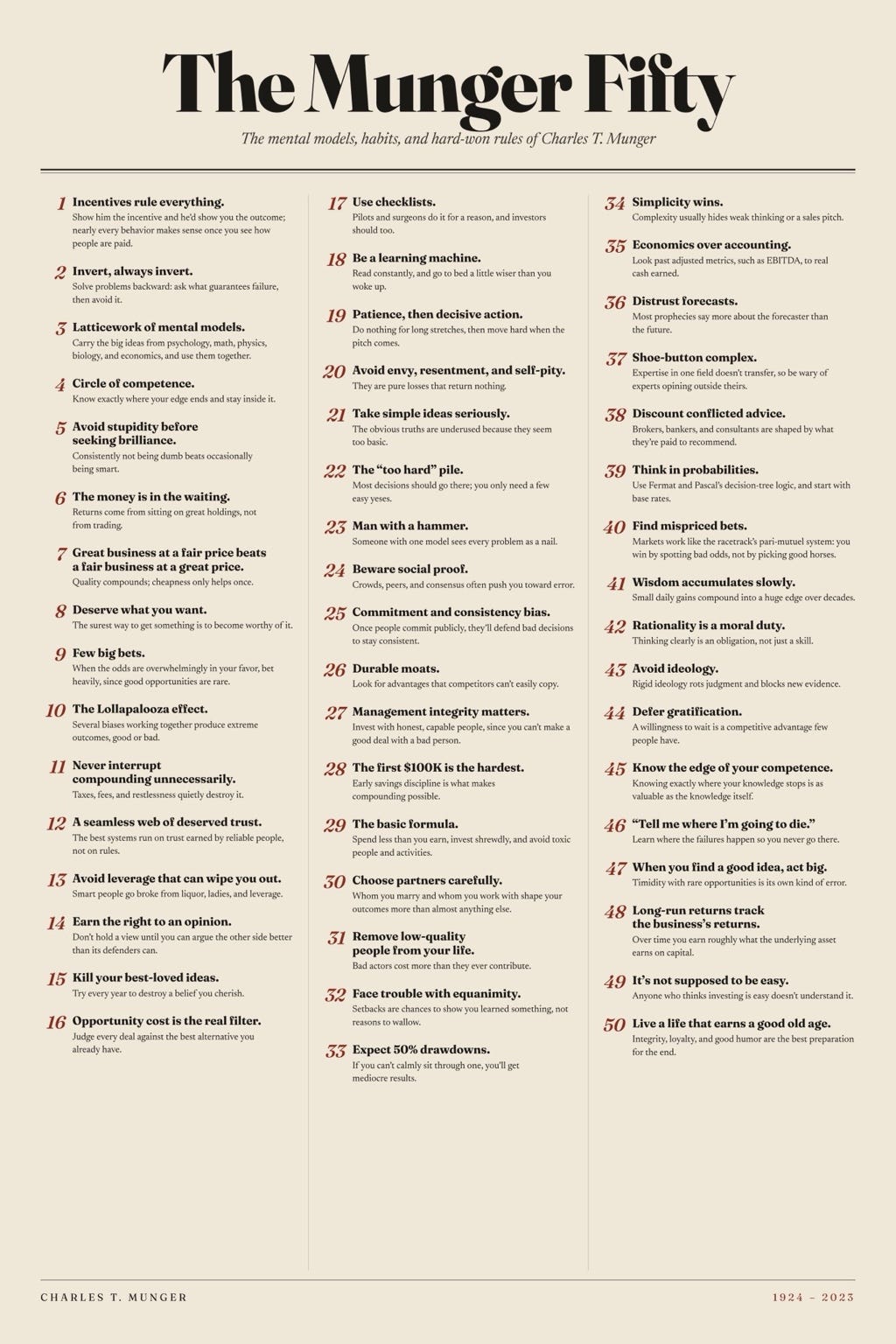
I haven’t written in awhile. I'm not sure if it’s due to a creative block or from just not wanting to write. I am back now however because I came across this “poster” that distills Mungers ideas. This instantly reminded me just how remarkable Charlie Munger was and how much his writings, talks, and speeches shaped the investor I became. So, I am back with this essay on Munger.
I first read Poor Charlie’s Almanack years ago, and it is one of the relatively small number of books I continue to return to. My copy has never really been “finished.” I have read and reread sections, returned to Munger’s speeches, listened to his answers at shareholder meetings, and found myself thinking about his ideas in circumstances that have nothing to do with investing. I sometimes have the word Lalapalooza run through my mind unprovoked. There are books that give you information, and there are books that subtly alter the machinery you use to process information. Munger’s work did the latter for me and it continues to do so as I age and begin passing on things to my children.
His influence on me initially came through investing, which is probably true for most people who discover him through Warren Buffett and Berkshire Hathaway. When I formed my first investment fund, I deliberately modeled its basic structure and principles on Buffett’s original partnerships. Buffett Associates began in 1956 as a limited partnership, with Buffett serving as general partner and family and friends providing most of the original capital. I was attracted not only to Buffett’s investment record but to the underlying logic of the arrangement: the manager and investors should be partners, their economic interests should be aligned, and the manager should think like an owner rather than an asset gatherer. That philosophy naturally led me deeper into Munger, because Munger supplied something Buffett alone did not: a broader intellectual framework for understanding why good investors and good decision-makers generally think differently.
“In my whole life, I have known no wise people (over a broad subject matter area) who didn't read all the time -- none, zero. You'd be amazed at how much Warren reads--and at how much I read. My children laugh at me. They think I'm a book with a couple of legs sticking out.” - Charles T. Munger, Poor Charlie's Almanack: The Wit and Wisdom of Charles T. Munger
The older I get, the less I think of Munger primarily as an investor. Investing was simply the arena in which his philosophy could be measured with unusual precision. Capital provides a scoreboard and who doesn’t want to have the most points on the board? You make decisions under uncertainty, reality eventually renders a verdict, and the results compound. But Munger was interested in a much larger question: How does a person learn to think clearly?
His answer was not to become brilliant. In fact, much of Munger’s philosophy is suspicious of brilliance. Clever people can construct extraordinarily sophisticated explanations for terrible decisions. Intelligence gives us more powerful tools, but it does not necessarily tell us where to point them. Munger was more interested in avoiding predictable stupidity. As he once put it, “All I want to know is where I’m going to die, so I’ll never go there.” The humor masks a serious philosophy. If you can identify the behaviors and decisions capable of producing ruin, avoiding them can matter more than finding another way to optimize everything else.
That is inversion - always INVERT, perhaps the most characteristically Mungerian way of looking at a problem. Instead of merely asking how something succeeds, ask how it fails. Instead of asking how to become wealthy, ask what reliably destroys wealth. Instead of asking how to build a durable business, identify what destroys otherwise good businesses. Instead of asking what makes a good partnership, study what makes partnerships collapse. The answers are often surprisingly mundane: excessive leverage, bad incentives, dishonesty, envy, uncontrolled spending, fragile business models, poor partners, overconfidence, and an inability to admit mistakes. Success remains complicated, but failure begins to look remarkably repetitive.
This has become increasingly useful to me because I have come to believe that avoiding catastrophic mistakes is badly underrated. There is an asymmetry between creation and destruction. Years of disciplined compounding can be undone by a single sufficiently bad decision. Nassim Taleb probably did the most in recent memory to popularize this idea, but Munger laid it out the best. A business can survive hundreds of ordinary days and be destroyed by one reckless transaction. A reputation can take decades to construct and an afternoon to lose. An investment portfolio can survive mediocre returns far more easily than it can survive excessive leverage at precisely the wrong moment. Munger understood that survival itself has enormous economic value because survival preserves the ability to compound.
“We all are learning, modifying, or destroying ideas all the time. Rapid destruction of your ideas when the time is right is one of the most valuable qualities you can acquire. You must force yourself to consider arguments on the other side.” - Charles T. Munger
Compounding, of course, sits near the center of the Buffett-Munger worldview. But I think their insight about compounding extends well beyond money. Knowledge compounds. Relationships compound. Trust compounds. Reputation compounds. Good habits compound. So do bad ones. The effects are difficult to perceive from one day to the next because very little seems to happen. Over decades, the difference becomes enormous. Munger described the process of becoming wiser in similarly incremental terms: “Go to bed a little wiser than you were when you woke up.” There is nothing dramatic about that prescription. That is precisely the point.
His concept of a “latticework of mental models” had an especially strong influence on how I think. Munger rejected the tendency to interpret the world through a single discipline. Reality does not care how universities organize their departments. A business problem can simultaneously be a problem of economics, psychology, mathematics, incentives, sociology, and probability. If you know only economics, you will try to make everything an economics problem. If you know only finance, everything begins to look like a financial problem. Munger borrowed the old observation that “to a man with only a hammer, every problem looks pretty much like a nail.” His solution was to acquire more tools.
This does not mean becoming an expert in every field. It means understanding the handful of powerful ideas from the major disciplines that explain a disproportionate amount of reality. From mathematics comes probability and compounding. From economics come incentives and opportunity cost. Psychology gives us cognitive biases and social proof. Engineering teaches redundancy, break points, and margins of safety. Biology gives us adaptation, competition, and ecosystems. History provides the uncomfortable reminder that human nature changes much less than technology does. Once those ideas begin interacting, knowledge becomes more useful because a new fact has somewhere to attach itself.
Munger’s thinking about incentives may be the principle I notice most frequently in everyday life. “Show me the incentive and I will show you the outcome” is now closely associated with him, and his actual discussions of incentives were even more revealing. In his famous Psychology of Human Misjudgment talk, Munger said that despite considering himself unusually attuned to incentives throughout his life, he had still consistently underestimated their power. Munger Archive That observation has stayed with me because it changes the first question one asks when confronted with seemingly irrational behavior.
When an organization behaves strangely, look at the incentives. When a salesperson makes a recommendation, look at the incentives. When an executive pursues a particular metric, look at the incentives. When an investment manager recommends a product, look at the incentives. Munger was not arguing that everyone is consciously corrupt. His point was subtler and more unsettling: incentives can change what people sincerely believe. In his discussion of “incentive-caused bias,” he described how people can rationalize conduct that serves their interests without fully recognizing what they are doing. Chian That makes incentives more powerful than simple bribery. They can alter cognition itself.
The lesson applies just as forcefully inward. It is easy to identify everyone else’s conflicts of interest and remarkably difficult to recognize our own. We become attached to investments we own, businesses we have built, opinions we have stated publicly, and decisions into which we have already poured time and money. Our minds then become attorneys rather than judges. We begin assembling evidence for the defense.
That is why another Munger principle has become increasingly important to me: earning the right to have an opinion. He argued that you should be able to state the arguments against your position at least as well as the people who hold them before considering yourself entitled to a strong view. That is a demanding standard. It means actively searching for evidence that could destroy an idea you like. It means asking what would have to be true for you to be wrong. And it means separating your identity from your conclusions so that changing your mind becomes evidence of learning rather than an admission of weakness.
This is much easier to admire than to practice. Intelligence can actually make the problem worse because intelligent people are often exceptionally good at rationalization. Given enough information, almost any conclusion can be defended. Munger therefore emphasized a kind of intellectual hygiene: checklists, inversion, disconfirming evidence, multidisciplinary thinking, and deliberate awareness of psychological bias. These were not tricks for becoming smarter. They were safeguards against using intelligence badly.
“Acquire worldly wisdom and adjust your behavior accordingly. If your new behavior gives you a little temporary unpopularity with your peer group…then to hell with them.” - Charles T. Munger, Poor Charlie's Almanack: The Wit and Wisdom of Charles T. Munger
One of the ideas on the Munger poster that particularly appeals to me is the “too hard” pile. There is tremendous freedom in accepting that some questions do not need to be answered. Investors are constantly encouraged to have opinions. Where are interest rates going? What will the market do next year? Which technology will dominate ten years from now? Munger’s response to many such questions was effectively: I don’t know, and I don’t need to know. The important thing is not having a large circle of competence. It is knowing where its boundary lies.
That sounds conservative until you combine it with another Munger principle: when the odds are overwhelmingly in your favor, act decisively. This is where his philosophy becomes much more interesting. Munger was not temperamentally timid. He was selectively aggressive. Most opportunities belong in the too-hard pile or are simply not attractive enough. A few are understandable, durable, and significantly mispriced. Those are the moments when patience should give way to action.
This explains the apparent contradiction between extreme patience and concentrated investing. If truly exceptional opportunities are rare, it makes little sense to behave as though your twentieth-best idea deserves the same capital as your best idea. But the right to concentrate must be earned. Concentration without understanding is merely gambling. Munger’s framework requires you first to remain inside your circle of competence, examine the contrary argument, consider the incentives, think probabilistically, demand an adequate margin of safety, and then, only then, have the courage to act substantially.
That idea has always appealed to me more than the constant activity that dominates modern finance. There is an enormous institutional incentive to do something. Trade. Forecast. Rebalance. Produce another product. Make another prediction. Yet one of the great lessons of Buffett and Munger is that activity and productivity are not synonymous. Sometimes the economically rational decision is to sit still for a very long time. A great business does not become more valuable because you repeatedly buy and sell its shares. Compounding requires time more than excitement. Opportunity cost ties much of this together. Munger understood that the correct comparison for an investment is not cash or some abstract hurdle rate; it is the best alternative available. The same principle extends far beyond a portfolio. A business opportunity can be profitable and still be a poor use of capital. A meeting can be useful and still be a poor use of an hour. An investment can have an attractive expected return and still be inferior to another investment. Once opportunity cost becomes habitual, “Is this good?” is no longer an adequate question. The question becomes, “Compared with what?”
Perhaps this is why I continue returning to Munger after all these years. I originally encountered him through investing, and his ideas unquestionably shaped the way I thought about my own fund. But their usefulness has expanded rather than contracted with time. I find myself applying them to businesses, partnerships, hiring, family decisions, risk, and even the allocation of my own attention. The common denominator is judgment.
“I constantly see people rise in life who are not the smartest, sometimes not even the most diligent, but they are learning machines. They go to bed every night a little wiser than they were when they got up and boy does that help, particularly when you have a long run ahead of you.” - Charles T. Munger
There is also something deeply unfashionable about Munger that I appreciate more with age. He believed in deferred gratification. He distrusted envy. He disliked self-pity. He thought reading was indispensable. He believed reputation mattered enormously. He regarded rationality almost as a moral responsibility. And he was deeply skeptical of ideologies that offered complete explanations of the world. These ideas do not promise immediate transformation. They demand decades.
Near the end of the poster is the admonition to “live a life that earns a good old age.” That may ultimately be a better summary of Munger than anything he said about stocks. His worldview was fundamentally about compounding the things worth having while avoiding the things capable of destroying them. Capital, knowledge, relationships, reputation, and wisdom are all accumulated slowly. Catastrophe, by contrast, can arrive quickly.
I first opened Poor Charlie’s Almanack because I wanted to become a better investor. I continue returning to it because Munger was writing about something much larger. He was trying to understand how a person could navigate an uncertain world without being repeatedly deceived by other people, by incentives, by crowds, and most importantly by his own mind.
His answer was not a grand theory. It was a collection of relatively simple disciplines practiced for an extraordinarily long time: read constantly, think across disciplines, understand incentives, invert problems, respect opportunity cost, know what you do not know, destroy your favorite ideas, avoid ruin, wait patiently, and act decisively when the odds finally justify it.
None of these principles is particularly impressive in isolation. That may be the most Munger-like thing about them. Their power comes from combination and repetition. Applied once, they seem like common sense. Applied consistently for decades, they become something else entirely. They compound.