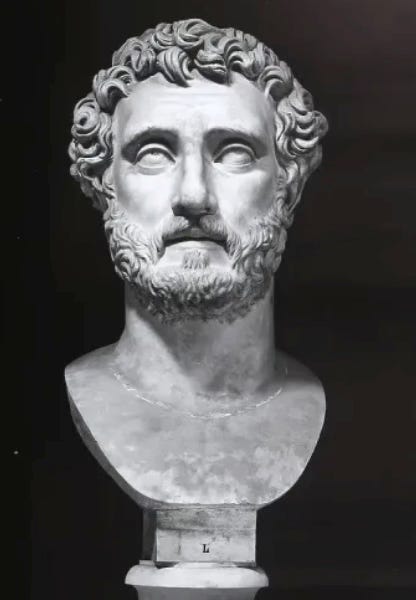
On The Emperor Who Didn’t Need to Write
Why Antoninus Pius Lived the Stoicism Marcus Aurelius Had to Record
“Concentrate every minute like a Roman-like a man-on doing what’s in front of you with precise and genuine seriousness, tenderly, willingly, with justice. And on freeing yourself from all other distractions. Yes, you can-if you do everything as if it were the last thing you were doing in your life, and stop being aimless, stop letting your emotions override what your mind tells you, stop being hypocritical, self centered, irritable. You see how few things you have to do to live a satisfying and relevant life? If you can manage this, that’s all even the gods can ask of you.” - Marcus Aurelius
I often return to Meditations by Marcus Aurelius. Each reading yields something different, as all serious works do. This time, what stood out was not Marcus himself, but the figure who haunts the book’s opening pages: his adoptive father, Antoninus Pius. Marcus wrote relentlessly about virtue. Antoninus practiced it. One left us words. The other left us order. Facta, non verba.
History has a literary bias. It remembers those who leave words and forgets those who leave order. This bias explains why Marcus Aurelius is celebrated as the philosopher-king while Antoninus Pius is treated as a preface, an interlude between Hadrian’s ambition and Marcus’s introspection. Yet if Stoicism is a philosophy meant not to be admired but to be lived, the hierarchy should be reversed. Marcus wrote about virtue. Antoninus embodied it. And embodiment, not articulation, is the higher proof.
Modern readers approach Meditations as a manual. They underline passages, quote lines, extract maxims, and treat the book as a portable Stoic toolkit. This is understandable. The text is intimate, severe, and unusually honest for a man who ruled an empire. But it is also misleading. Meditations is not evidence that Marcus mastered Stoicism. It is evidence that he needed it. The notebook exists because virtue, for Marcus, was no longer ambient. It had to be summoned, rehearsed, and defended against fatigue, anger, grief, and the slow corrosion of power.
Antoninus left no such record. Not because he lacked philosophical depth, but because he did not experience philosophy as an interior struggle. He governed as if order were still possible without constant moral self-interrogation. He ruled in a way that made reflection unnecessary. This difference is the key to understanding both men and the decline they straddle.
Antoninus Pius ruled Rome for nearly a quarter century. He did so without civil war, without purges, without expansionist frenzy, without theatrical cruelty, and without leaving Italy. These facts alone should command attention. In a system that rewarded paranoia, he trusted institutions. In a culture that often collapsed into spectacle, he preferred continuity. In an office that tempted men toward vanity, he showed no hunger to be seen. His reign was not exciting. It was stable. And stability, in a great power, is never accidental.
The title Pius was not flattery. It described a temperament. Pietas in Roman terms meant right order, toward the gods, toward family, toward the dead, toward the laws, toward the city itself. Antoninus’s piety was not mystical. It was administrative. He honored Hadrian’s memory when the Senate wished to erase it. He honored the law even when expediency would have been easier. He honored the limits of power by refusing to dramatize it. He behaved as if the emperor were a steward rather than a performer. This is why Marcus begins Meditations not with doctrine but with gratitude. Book I is not philosophical exposition; it is moral inventory. Marcus lists the people who shaped him, and when he reaches Antoninus, the tone changes. The virtues he names are not clever. They are not speculative. They are habits. Gentleness without weakness. Firmness without harshness. Decisiveness without anxiety. Affection without indulgence. Acceptance without arrogance. Relinquishment without struggle. These are not ideals one adopts. They are postures one inhabits.
What is striking is not only what Marcus says, but what he does not say. He does not praise Antoninus for brilliance. He does not praise him for originality. He does not praise him for vision or reform. He praises him for absence, for the absence of vanity, of cruelty, of panic, of indulgence, of moral theater. Antoninus is presented as a man whose power did not distort him. That alone places him among the rarest rulers in history.
“You are an old man. Stop allowing your mind to be a slave, to be jerked about by selfish impulses, to kick against fate and the present, and to mistrust the future.” - Marcus Aurelius
Marcus, by contrast, ruled under pressure. The empire he inherited was already strained. The frontiers were brittle. The military was more professional but also more expensive and more restless. The Senate was compliant but hollowed out. The moral consensus that had sustained the adoptive succession was weakening. And then came the shocks: prolonged wars along the Danube, demographic strain, fiscal pressure, and the Antonine Plague, a catastrophe that killed millions and reshaped the empire’s future. Marcus did not choose these conditions. But he had to govern within them. Meditations is the sound of a man trying to remain just while the ground shifts beneath him. It is not serene. It is urgent. Marcus reminds himself not to grow angry at the stupidity of others, not to resent the ingratitude of the world, not to forget that power is temporary and death is near. These reminders are not ornamental. They are defensive. The book exists because Marcus feels the constant pull toward bitterness and despair. Stoicism, for him, is resistance.
This distinction matters because it reframes Marcus’s mistakes. He is often lauded as a great emperor without qualification, but his reign contains tragic errors. The most consequential is the elevation of Commodus as successor. The adoptive principle that had stabilized Rome for nearly a century was abandoned in favor of dynastic instinct. This was not a Stoic decision. It was a paternal one. Marcus chose blood over fitness, and the result was catastrophic. Commodus did not merely fail; he inverted the Antonine model. Where Antoninus exercised restraint, Commodus indulged. Where Antoninus avoided spectacle, Commodus embraced it. The empire did not collapse overnight, but the moral center did. Marcus also normalized emergency governance. Prolonged war hardened administrative habits. Exceptional measures became routine. The empire learned to live in a state of chronic mobilization. None of this was born of cruelty. It was born of exhaustion. Marcus governed well under impossible conditions, but governance under strain inevitably leaves scars.
Antoninus faced none of these tests because he preserved the conditions that prevented them. His restraint was preventative, not reactive. He did not need to write reminders to himself because he did not allow circumstances to degrade to the point where reminders were necessary. This is not luck. It is prudence exercised early and consistently.
To tap in the Greeks, a comparison to Socrates and Plato is instructive. Socrates wrote nothing. Plato wrote because the city that produced Socrates killed him. The text appears when the life can no longer transmit itself intact. Plato’s dialogues are acts of preservation. They exist because something essential had already been lost. Marcus’s Meditations serve a similar function. They preserve an image of Antonine virtue at the moment it begins to slip from the world. This pattern repeats throughout history. The age that lives virtue does not write about it. The age that writes about virtue does so because it no longer trusts itself to live it. We are such an age. We produce endless commentary on ethics, leadership, mindfulness, and resilience. We valorize reflection and confession. We mistake moral articulation for moral achievement. In doing so, we repeat the mistake that has relegated Antoninus to the margins.
Antoninus is difficult for modern readers to appreciate because he offers no interior drama. There is no text to mine, no aphorisms to quote, no psychological struggle to admire. His greatness is administrative and therefore invisible. He demonstrates that philosophy can be fully absorbed into character, that virtue can become boring, and that boredom, in governance, is a form of excellence.
Marcus knew this. That is why Book I of Meditations exists at all. It is a ledger of debts. It acknowledges that the highest model of rule Marcus ever encountered did not speak in maxims. It acted. Marcus writes because he must reconstruct, within himself, the posture that Antoninus embodied effortlessly. This inversion has implications beyond Roman history. It challenges how we evaluate leaders, thinkers, and moral exemplars. We gravitate toward those who explain themselves. We distrust those who do not. We assume silence hides emptiness. Often it hides completion. Antoninus did not need to persuade. He did not need to justify. He did not need to narrate his virtue. He administered it daily, for decades, without deviation.
If Marcus represents Stoicism under siege, Antoninus represents Stoicism at home. If Marcus is admirable for his honesty and endurance, Antoninus is admirable for his prevention of tragedy. The former makes for better literature. The latter makes for better civilization. History prefers Marcus because history prefers voices. But if the question is not who wrote most beautifully about virtue, but who most fully realized it in power, the answer is clear. The emperor who did not need to write deserves more attention than the one who did. Marcus Aurelius is remembered because he left us words. Antoninus Pius is forgotten because he left us peace. That is not a verdict on their characters. It is a verdict on our priorities.


