

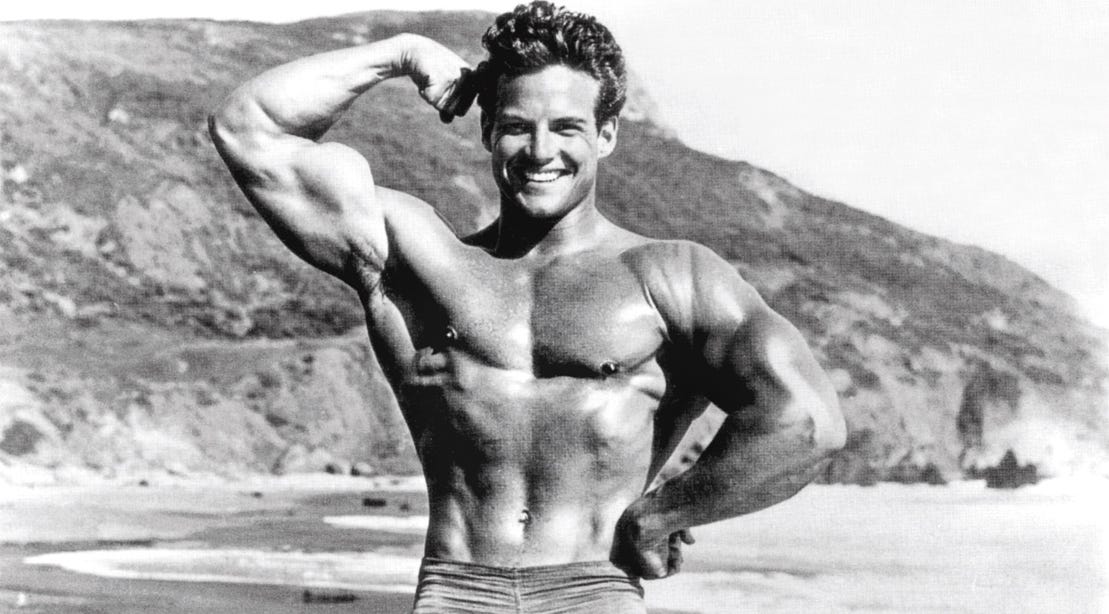
“Modern bodybuilding is ritual, religion, sport, art, and science, awash in Western chemistry and mathematics. Defying nature, it surpasses it.” - Camille Paglia
Have you ever taken a dumbbell to the face and survived to tell the tale? My wife has.
Not many people know this about me, but I was a teenage bodybuilder. Long before mortgages, executive meetings, children, and the occasional reminder from my lower back that I am no longer nineteen, I spent a considerable amount of time in gyms trying to build muscle. Looking back, one of the most important lessons from that period of my life is surprisingly simple: do not hit your future wife in the face with a dumbbell while warming up for your first bodybuilding competition. It tends to distract from the task at hand, you need to be focused to flare your lats and pop your calves!
The incident was entirely accidental, though that distinction did not seem especially important at the time. We were backstage preparing for prejudging. Competitors were nervously moving through their warm-up routines, resistance bands were snapping, and everyone was desperately trying to coax a few more ounces of blood into muscles that had already been trained, starved, and scrutinized for months. In the middle of this chaos, a dumbbell found its way into my girlfriend’s face. She survived, thankfully, and later married me despite the harrowing experience.
The second lesson from that season of life was equally valuable. When I was nineteen, I proposed to my then-girlfriend and simultaneously decided to compete in my first bodybuilding show. In hindsight, I would advise young men to avoid doing both at the same time. Bodybuilding is frequently described as a discipline, and that description is accurate as far as it goes. What is mentioned less often is that bodybuilding is also an extraordinarily selfish pursuit. Every aspect of life becomes organized around the requirements of training. Meals are planned, workouts are scheduled, sleep is monitored, social events are avoided, and every decision is filtered through the question of whether it will help or hinder progress. Such focus may be useful when preparing for a competition, but it is not always conducive to being an attentive fiancé. Your fiancé might not be thrilled about you taking time away to do MORE cardio or that your libido is shot because you are restricting yourself from food.
The show itself was held in a local high school auditorium. Former Mr. Olympia Jay Cutler was the guest poser. Those who know him today likely know him as an online personality dispensing fitness advice to millions of followers, but at the time he was one of the dominant figures in professional bodybuilding. Seeing a professional bodybuilder in person is an unusual experience. Television and photographs fail to communicate the scale. A man like Jay Cutler does not appear merely muscular; he appears almost implausible, as though he belongs to a slightly different species.
The atmosphere backstage remains vivid in my memory. You could smell the tanning products and protein powder before reaching the building. The competitors paced nervously through narrow hallways carrying rice cakes with honey, water bottles, and resistance bands. The posing trunks were, as tradition demands, hiked to heights that would make ordinary citizens uncomfortable. Every competitor was simultaneously attempting to appear relaxed while obsessing over every visible detail of his physique. To an outsider, the entire spectacle would have appeared ridiculous. A collection of nearly naked men covered in artificial tan stood under fluorescent lights flexing muscles that most people did not know existed. There was something undeniably absurd about it.
“I don’t eat for taste, I eat for function.” - Jay Cutler
Yet over time I have come to believe that the absurdity obscures something important. Years later I encountered a line from Camille Paglia that captured what I had sensed but never fully articulated. Writing about bodybuilding, she observed that it is “ritual, religion, sport, art, and science, awash in Western chemistry and mathematics. Defying nature, it surpasses it.”
Most readers probably encounter that sentence and think about bodybuilding. I encounter it and think about civilization and some bodybuilding, I mean the first few paragraphs were to let you know that I was a bodybuilder and that my back double bi was spectacular.
The bodybuilder is one of the most misunderstood figures in modern culture because people tend to mistake the visible activity for the underlying impulse. They see vanity where there is often aspiration. They see narcissism where there is frequently discipline. They see appearance where there is often a deeper desire for transformation. None of this is to deny that vanity exists within bodybuilding. It certainly does. Human beings are capable of corrupting any worthwhile endeavor. Religion can become vanity. Scholarship can become vanity. Politics can become vanity. Physical culture is no exception. Yet to reduce bodybuilding to vanity is to miss the larger significance of the enterprise.
What fascinated Paglia, and what increasingly fascinates me, is that bodybuilding represents a distinctly civilizational instinct. Nature provides the starting point, but civilization begins when human beings decide that the starting point is insufficient. Agriculture is unnatural. Medicine is unnatural. Architecture is unnatural. The law is unnatural. Universities are unnatural. Every significant human achievement represents, in some sense, a refusal to accept the conditions that nature initially provides. The bodybuilder simply conducts this experiment on the most intimate material available, his own flesh.
This strikes many modern people as an uncomfortable observation because we increasingly associate the natural with the good. Natural foods, natural lifestyles, natural products, and natural solutions are all assumed to possess an inherent virtue. Yet nature itself offers no such guarantee. Nature is beautiful, but it is also indifferent. Nature produces sunsets and cancer, abundance and famine, strength and decay. Civilization emerged not because human beings accepted nature but because they continually sought to improve upon it. The story of civilization is therefore not a story of passive coexistence but of active transformation.
Seen from this perspective, bodybuilding becomes less an athletic activity than a metaphor. The bodybuilder looks at the body he has been given and decides it is unfinished. Through discipline, repetition, calculation, and sacrifice, he attempts to transform it into something better. Whether he succeeds is ultimately less important than the aspiration itself. The aspiration reveals something essential about the human condition. We are creatures who are perpetually dissatisfied with what merely is. We are always reaching toward what could be.
The Greeks understood this instinct well. Their admiration for athletic excellence was never simply admiration for physical appearance. Rather, it reflected a deeper appreciation for the cultivation of human potential. Aristotle, perhaps more than any philosopher, recognized that excellence is not natural. Virtue is not inherited. Character is not accidental. Excellence emerges through habit, repetition, and practice. A courageous man becomes courageous through courageous acts. A disciplined man becomes disciplined through disciplined acts. In this sense, the bodybuilder is applying Aristotelian principles to muscle and bone. The physique is merely the visible consequence of invisible habits accumulated over time.
Nietzsche would have recognized something similar. His philosophy is animated by the idea of self-overcoming. Human beings become fully themselves not by remaining static but by continually transcending previous limitations. The bodybuilder embodies a literal version of this process. He treats the body not as a fixed reality but as a project. Every training session becomes a small act of self-creation. Every improvement, however minor, becomes evidence that transformation is possible.
This is one reason I have increasingly come to believe that bodybuilding, despite its eccentricities, contains a profound lesson about civilization itself. The lesson is not that everyone should become a bodybuilder. Most people should not. The lesson is that excellence always appears excessive from the outside. Extreme defines normal. The existence of extraordinary athletes expands our understanding of athletic potential. The existence of extraordinary thinkers expands our understanding of intellectual potential. The existence of extraordinary physiques expands our understanding of physical potential. The purpose of the extreme is not imitation. It is revelation.
Civilizations advance because some individuals are willing to explore the outer boundaries of what is possible. Most people will never become Olympic athletes, master craftsmen, saints, philosophers, or bodybuilders. Yet these figures serve an important function. They establish horizons. They reveal capacities that would otherwise remain hidden. They demonstrate what human beings can become when discipline, imagination, and effort are combined toward a singular purpose.
When I think back to that high school auditorium, I no longer see merely a collection of young men flexing beneath bright lights. I see something stranger and, in its own way, more meaningful. Beneath all the tanning oil, posing trunks, protein powder, and vanity was an ancient human impulse. It was the impulse that built cathedrals, crossed oceans, founded universities, and landed men on the moon. It was the refusal to remain what nature had first made possible.
That is why Paglia’s observation has stayed with me. Modern bodybuilding is indeed ritual, religion, sport, art, and science. More importantly, it is a reminder that civilization itself is built upon a simple and enduring act of defiance. Human beings look at the world, look at themselves, and decide that both can be improved. The bodybuilder merely makes that impulse visible. He becomes both sculptor and stone, engaged in the oldest project of civilization: transforming what is into what might be.