On Art Is Not the Cure
Why Great Art Is a Consequence, Not a Cause
“Before art can flourish, the people themselves must flourish.” - Richard Wagner
Modern culture consoles itself with a dangerous fiction: that art leads civilization. That artists can drag a disintegrating society forward through imagination while its families, rituals, and institutions rot. When the collapse becomes impossible to ignore, the prescription never changes. Subsidize creativity. Platform voices. Flood the public square with expression. All to avoid the harder truth, that no amount of art can save a society unwilling to discipline itself.
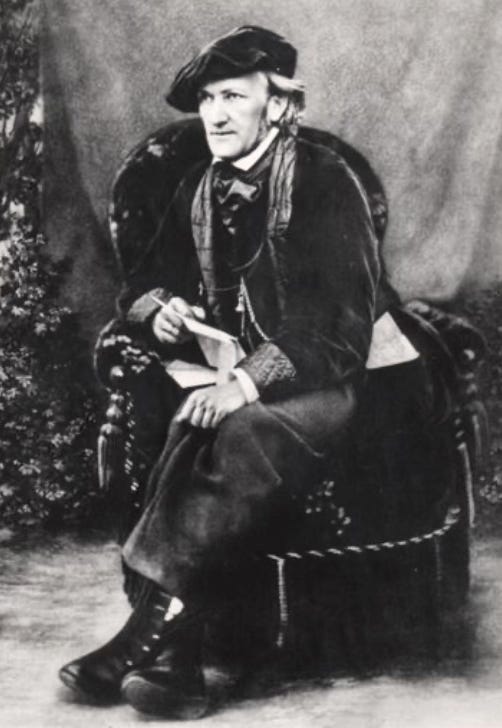
Richard Wagner rejected this myth outright. In Art and Revolution, he argued the opposite: art does not heal a sick society; it merely reveals its sickness. When a people are whole, art is whole. When they fragment, art fragments with them. Art is not a lever. It is a mirror.
Wagner’s provocation remains unsettling because it removes our favorite escape hatch. If art cannot save us, then neither taste nor aesthetics can substitute for order. A decayed society cannot outsource its regeneration to galleries, playlists, or grant committees. It must first recover the conditions that make art possible at all. Wagner locates his ideal not in utopian speculation but in history. He turns to ancient Greece, where art was not a profession but a civic act. Tragedy was not consumed by an elite class of patrons or critics; it was embedded in ritual, religion, and public life. Art emerged from a shared moral horizon. The artist did not speak to the people; he spoke from them.
Modern art, by contrast, is born into fragmentation. We live amid specialized markets, atomized audiences, and an economy that reduces all output to commodities. Art is purchased, streamed, branded, monetized, and optimized. The artist becomes either a servant of capital or a solitary rebel performing originality for its own sake. In both cases, art loses its grounding in common life. It floats. This is not an argument about talent. Wagner never claimed modern artists lack skill. He claimed they lack a people. Without shared myths, stable institutions, and a moral grammar held in common, even brilliance dissolves into novelty. What looks like innovation is often just noise generated in a vacuum.
The modern instinct is to reverse the causal chain. We imagine that if we elevate the arts, society will follow. Wagner insists this is backward. Art does not precede social order; it presupposes it. Beauty is not an independent variable. It is an output. This explains why modern cultural policy feels so futile. We subsidize museums while families disintegrate. We champion creativity while rituals vanish. We praise expression while disciplining nothing else. The result is predictable: an abundance of content, a poverty of meaning.
Wagner’s critique cuts deeper still. He argues that capitalism does not merely distort art economically; it reshapes it ontologically. When art must survive by demand, it adapts to taste rather than truth. It flatters, distracts, shocks, or entertains. It rarely forms. The audience becomes a market, not a community. Consumption replaces participation.
This is why the modern artist oscillates between narcissism and resentment. On one side stands the performer chasing attention in an oversaturated marketplace. On the other stands the alienated critic, angry at a public that no longer listens. Both are symptoms of the same condition: the absence of a shared world. Wagner’s answer is often misunderstood as purely political revolution. It is not. He is explicit that changing rulers or laws without changing social life accomplishes nothing. His revolution is anthropological. It concerns how people live together, what they honor, what they sacrifice for, and what binds them beyond preference.
“No culture can appear or develop except in relation to a religion.” - T.S. Eliot
Only when social life is reintegrated, when family, ritual, labor, and belief regain coherence, can art re-emerge as something more than entertainment. Only then can music, poetry, and drama reunite as expressions of a people rather than products for consumers. This perspective is bracing because it denies us aesthetic shortcuts. It tells us that no amount of “better art” will compensate for weak families, thin moral formation, or a desacralized public square. If art is hollow, it is because life is hollow first.
The implication is uncomfortable but clarifying. Cultural renewal does not begin in studios or universities. It begins in homes, churches, schools, and shared practices that demand discipline rather than self-expression. It begins with the recovery of limits, hierarchies, and obligations that modernity treats as oppressive but which every durable civilization has required.
The call to action, then, is not to create more art, but to live more formatively. Rebuild institutions that bind rather than indulge. Restore rituals that outlast moods. Demand standards in education, work, and family life that shape character before taste. Resist the lie that expression without formation is freedom. It is not. It is drift. If art is to recover depth, society must recover gravity. Artists will follow when there is something worth speaking for again. Do not ask what art can do for society. Ask what kind of society is worthy of great art and begin there.


